
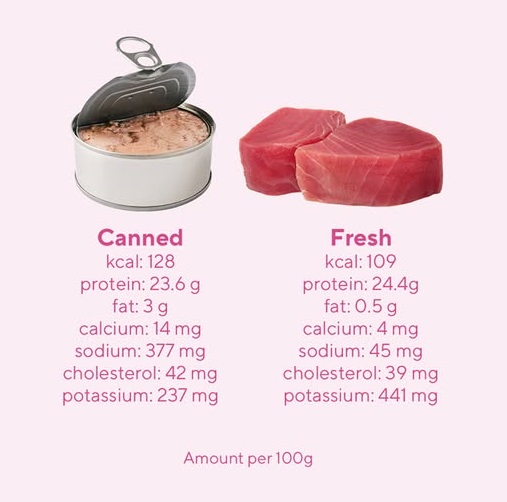
Key Nutritional Breakdown (Per 100g Light Tuna Canned in Water, Drained)
According to the USDA FoodData Central nutrient profiles, a 100-gram serving provides:
- Calories: 86 kcal
- Protein: 19.4 g to 23.3 g (Accounts for roughly 90% of its total calories)
- Total Fat: Less than 1 g (Virtually fat-free when packed in water)
- Carbohydrates: 0 g
Note: Fresh Bluefin or Yellowfin tuna steaks contain slightly more healthy fats (~4g to 8g) and run around 109 to 130 calories per 100g.
Core Health Benefits
- Elite Muscle Recovery: Because it is almost pure lean protein, tuna is exceptionally popular for weight management and lean muscle retention, providing high satiety with very few calories.
- Massive Vitamin B12 & B3 (Niacin) Supply: Tuna covers up to 100% of your daily Vitamin B12 and 84% of your Niacin. These vitamins work directly to enhance blood circulation, lower bad cholesterol, and prevent chronic fatigue.
- Immune & Thyroid Regulation: A single serving delivers an impressive 150% of your Daily Value for Selenium. This trace mineral behaves as a structural antioxidant to defend your cells from oxidative wear and tear.
- Brain & Heart Optimization: Even in lean canned varieties, it contains functional amounts of Omega-3 fatty acids (EPA and DHA) that support neurological focus, fight off low mood patterns, and preserve heart health.
Critical Health Consideration: Mercury Levels
Because tuna is a predatory fish, it accumulates mercury over time. To eat tuna safely:
- Choose “Light” Tuna: Canned chunk light tuna typically uses skipjack, which is smaller and contains significantly lower mercury than Albacore (“White”) or Bigeye tuna.
- Moderate Weekly Intake: Health authorities suggest keeping tuna consumption to 2 to 3 servings a week. Pregnant women and young children should strictly prioritize low-mercury options like skipjack over albacore.
Add Comment